close
Choose Your Site
Global
Social Media

 |


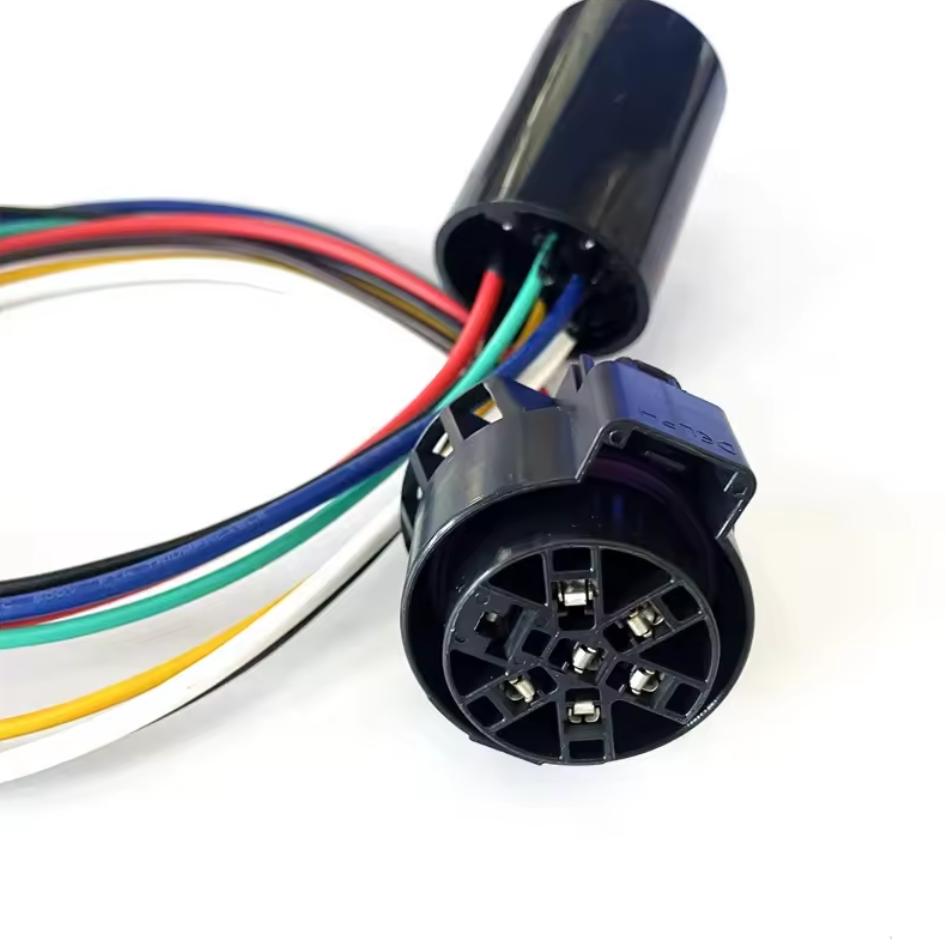
High-Performance Durable Strain-Relief Harness ensures superior connection stability and extended service life in demanding industrial and automotive applications. Its advanced strain-relief molding reduces cable stress by 80% and triples durability compared to standard harnesses, ideal for high-load and frequent-movement scenarios.
| Quantity: | |
|---|---|
Industrial Wiring Harness 6
Engineered to resolve persistent connectivity challenges in demanding environments, this durable strain-relief harness serves as the critical link for industrial machinery (excavators, conveyor belts, printing machines), automotive electronic systems (door wiring, seat adjustment motors, sunroof controllers), electrical control equipment (PLCs, frequency converters, servo drives), and precision instruments (CNC measuring machines, laser cutting equipment, semiconductor manufacturing tools). By fortifying the vulnerable junction between the cable and connector, it delivers unparalleled mechanical strength essential for heavy-duty machinery while ensuring the stable signal transmission required for precision measurement. The tactile firmness of the overmolded junction immediately conveys its readiness for rigorous daily operation, providing facility managers and procurement teams with a dependable solution that minimizes unexpected operational halts.
In heavy-duty industrial machinery such as excavators (exposed to frequent arm movement) and conveyor belts (continuous belt tension), unexpected downtime directly impacts profitability and total cost of ownership. The harness features a meticulously engineered strain relief molding design made of high-density PVC with a Shore hardness of 70A. This specific structural reinforcement resists frequent pulling (pull force resistance ≥100N) and intense vibration (10-500Hz, 5G acceleration). By actively preventing cable breakage at the connector junction and eliminating connection loosening caused by mechanical movement, this solution ensures the continuous operation of machinery, ultimately reducing maintenance downtime by 70% and maximizing the return on investment for equipment fleets.
Automotive environments expose wiring to relentless physical stress and extreme climates, making failure mode mitigation a top priority. For automotive door wiring (frequently opened/closed), engine compartment components (exposed to high temperatures and vibration), and other frequently moving parts, the specialized strain relief structure significantly reduces cable fatigue caused by repetitive opening/closing (enduring 100,000 bending cycles at 5× cable diameter) or constant engine vibration (10-2000Hz). Furthermore, the waterproof (IP67) rating and extreme high-temperature resistance (-40℃ to 150℃) ensure stable performance amid heavy rain or engine high-temperature operation. This targeted protection effectively avoids frustrating failures such as window lifting motor malfunctions, protecting the integrity of the entire electrical system.
In precision measuring instruments (e.g., coordinate measuring machines) and electronic control systems (e.g., semiconductor lithography equipment), even microscopic signal interruptions compromise operational integrity. The harness delivers exceptional anti-interference performance (complies with EN 55022 Class A for precision instruments) and low signal loss (≤0.1dB/m at 10MHz) to guarantee highly accurate data transmission. The strain relief molding, which is fully customizable to fit specific instrument enclosures, securely protects the connection point. This eliminates signal distortion caused by external forces, such as accidental touching during operation, and ensures strict measurement accuracy with an error margin of ≤0.001mm.
Superior Strain Resistance: Integrates advanced strain relief molding technology utilizing high-density PVC or TPU molding. This structural design effectively disperses cable stress away from the termination point, actively preventing damage from severe pulling (pull force resistance ≥100N), repetitive bending (100,000 cycles at 5× diameter), or extreme twisting (360° rotation 1000 times without damage). The resulting assembly extends service life by 3x compared to standard harnesses, offering a solid, unyielding feel that reassures operators during physical handling.
High Performance & Stability: Engineered to ensure highly efficient signal and power transmission without compromise. It boasts strong anti-interference capabilities (complies with EN 55022 Class A/B) to avoid signal loss (≤0.1dB/m at high frequencies) and power loss (≤3% at full load). The internal architecture maintains precise impedance stability (50Ω ±10% for high-frequency signals), providing consistent, reliable performance even when routed near electrically noisy equipment.
Strong Environmental Adaptability & Extreme Validation: Subjected to rigorous laboratory simulation testing, this harness proves its resilience in the field. It successfully resists UV radiation (ASTM G154, 3000 hours), intense vibration (10-500Hz, 5G), extreme high temperatures (-40℃ to 150℃), chemical fluid intrusion like oil pollution (engine oil, hydraulic oil), and moisture (IP67). This makes it highly adaptable to diverse harsh environments such as industrial workshops, automotive engine compartments, and exposed outdoor equipment.
Eco-Friendly & Reliable: Prioritizing environmental responsibility alongside industrial performance, the construction uses RoHS 2.0 and REACH-compliant environmental protection materials, significantly reducing harmful substance emissions. Each unit undergoes strict testing protocols—including 5000 insertion/extraction cycles and 1000-hour high-temperature aging—to ensure product reliability, achieving an impressive average failure-free time of ≥15,000 hours.
The foundation of reliable conductivity begins with premium raw materials. Cables are constructed from 99.9% high-purity oxygen-free copper, featuring exceptional conductivity (resistivity ≤0.0172Ω·mm²/m) and remarkably low resistance. Insulation materials include high-temperature silicone rubber (resists 200℃ for short periods), flame-retardant PVC (UL 94 V-0), and TPU (wear-resistant, Shore hardness 80A). These specific materials provide excellent insulation (breakdown voltage ≥30kV/mm) and mechanical strength (tensile strength ≥20MPa), emitting a clean, neutral scent indicative of pure industrial polymers. Strain relief molding materials utilize high-density PVC (Shore 70A) or TPU (Shore 80A), delivering a perfect balance of flexibility and impact resistance.
Versatility in termination ensures rapid integration into existing electrical systems. The design is fully compatible with Molex (Ultra-Fit series), JST (XH series), TE (AMP Superseal 1.5 series), Deutsch (DTP series), and other well-known brands. This guarantees a highly stable connection (contact resistance ≤5mΩ) and strong interchangeability across platforms. It supports various locking mechanisms (push-pull, threaded) to prevent accidental disconnection during heavy vibration; operators will hear a distinct, satisfying click upon mating. Push-pull connectors require a locking force of ≥12N, while threaded connectors utilize a secure torque of 0.5-1N·m.
Designed with installation and maintenance efficiency in mind, the compact architecture supports rapid assembly even in highly restricted spaces.
| Single Package Size & Weight | 20X15X10 cm | Net weight: 0.100 kg |
| Strain Relief Molding Size | 10mm×5mm to 30mm×15mm (compact design that does not occupy additional space) |
| Cable Cross-Sectional Area | 0.3mm² to 6mm² (AWG 22-10) |
| Maximum Current-Carrying Capacity | 40A (for 6mm² cables at 25℃) |
| Harness Bending Radius | ≥3× cable diameter (static) and ≥8× cable diameter (dynamic) |
Every assembly is backed by comprehensive international certifications, including IATF16949, ISO9001, CE, UL, and IEC 60332-1-2. We implement 100% pre-shipment testing to ensure each product strictly meets high-performance standards before reaching your facility. Testing items encompass strain resistance (pull force ≥100N), signal transmission loss (≤0.1dB/m), insulation resistance (≥300MΩ), and waterproof performance (IP67). Furthermore, the assemblies survive grueling 100,000 bending cycle tests and 5000 insertion/extraction cycle tests, providing documented proof of extreme durability.
We accept comprehensive OEM/ODM orders, focusing heavily on structural design and space optimization. Clients can customize strain relief molding shapes—choosing from straight, right-angle, or custom curved shapes—to perfectly fit specific equipment enclosures. We also tailor harness structures (single-ended, double-ended, or multi-branch), connector types (signal, power, or hybrid), and cable specifications (cross-sectional area, insulation material) according to exact customer equipment requirements, such as industrial machinery interface dimensions or precision instrument space constraints. To facilitate this, we provide detailed 2D/3D drawings and professional mold design services for custom molding.
Understanding that specialized engineering often requires agile manufacturing, we support small batch production with a minimum of just 3 units. This directly meets the personalized needs of special equipment (e.g., custom harnesses for vintage industrial machinery) and small-scale projects (e.g., precision instrument upgrades), dramatically improving market response speed. For these small batch orders, the production cycle is an efficient 4-8 working days. During this phase, flexible adjustment of specifications, such as molding shape and cable length, is fully allowed to ensure perfect alignment with project goals.
To assist in scientific selection and configuration, cable color (over 20 standard colors, including RGB options for color-coded wiring) and length (0.3m-12m, with 0.1m increments) can be customized freely. This flexibility is based on specific installation space constraints (e.g., narrow industrial machinery compartments) and complex layout requirements (e.g., long-distance connection between precision instruments). Proper configuration based on dynamic movement trajectories enhances installation convenience, ultimately reducing on-site installation time by 20%.
Our engineering team provides professional technical support throughout the procurement lifecycle. This includes advanced strain relief molding design, optimizing the geometry for maximum stress dispersion and precise space fit. We also offer harness structure optimization to reduce overall weight and improve flexibility, alongside mold manufacturing consultation for custom molding tools. To guarantee optimal field performance, we offer technical training for customer installation teams, ensuring the correct installation, routing, and use of all customized harnesses.
Risk mitigation is crucial before scaling production. We offer free samples (1-2 units) for rigorous customer testing and performance verification prior to mass manufacturing. These samples undergo comprehensive evaluations, including strain resistance testing (pull, bend), signal transmission testing (loss, interference), and environmental adaptability testing (high temperature, waterproof). The standard sample production cycle is 3-5 working days. If any design modifications are needed based on field trials, revised samples are provided within an accelerated 1-3 working days, ensuring the final product absolutely meets all equipment durability and performance requirements.